

The Illusion of Negativity
The human mind can be easily deceived. In its perennial effort to accurately interpret our world, it is unfortunately prone to making very serious mistakes. This is exceedingly evident in the case of optical illusions, were the mind is tricked into believing something that, in fact, is false. The image below, for instance, is completely static and unmoving, made by colors and patterns fixed in space. Is this what our mind perceives?
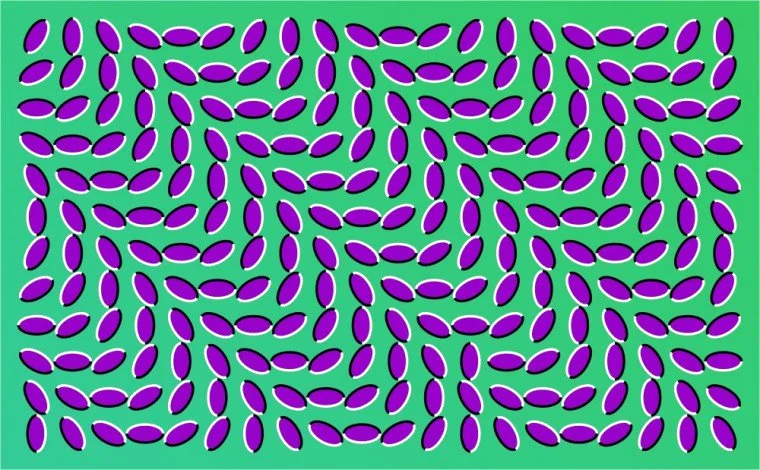
Here, we see movement where there is none. (This is a jpeg, not a video, I promise.) Our minds are simply not as trustworthy as we assume, which can severely complicate how we live our lives and how we understand the truth about the world around us. Now, look at the image below. What do you see? What’s the first word that comes to mind?
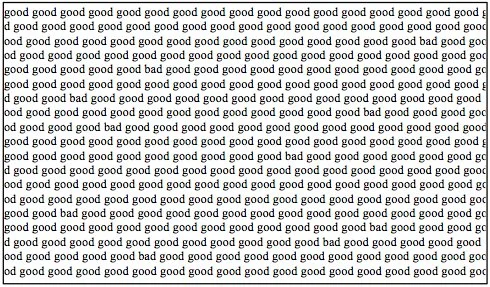
Undoubtedly, the word is "good." This is a metaphorical illustration of your life and the moments that comprise it. In real life, we have both "good" (pleasant, content, positive) and "bad" (unpleasant, discontent, negative) moments. And, as hard as it may be to recognize at times, our "good" moments far exceed our "bad." This is exactly what this illustration displays. Although the word "bad" appears a full ten times in the image above, the overall perception of the whole is "good." You may not have even spotted any of the “bad” at all! This is because, here, good and bad are favored equally, presented in the exact same font style and size. Your mind simply interpreted the sum total of what it was seeing to draw a quick conclusion. You saw the entire image as "good."
Unfortunately for us, when it comes to how we perceive our lives, this isn't how we operate. We do not put equal stock in our "good" and "bad" moments. Instead, we place far heavier weight on the moments we deem negative, seeing these as infinitely more relevant than all the "good." When we do this, the added emphasis we put on our “bad” moments leaves our lives suddenly looking like this:
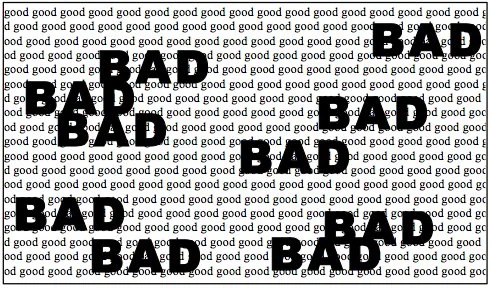
Now those ten “bad” moments are painfully obvious. And, here, what’s the first word that comes to mind? Bad, of course. And this is exactly what happens to us in real life, especially during challenging moments of discord or upset in a relationship. While in a state of distress, we cease viewing our lives from the objective perspective of the first image and instead fall for the optical illusion presented here. We let all the "good" fade into the background while the bad stands out in bold, oversized, upper-case font in our minds. We think about the totality of our current relationship, in an attempt to assess it, and we view it as:
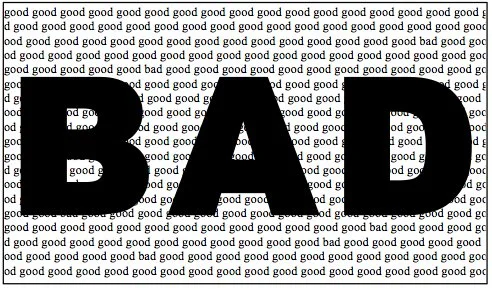
This is how our minds deceive us. This cognitive distortion warps objective reality and dupes us into believing something that simply isn't true. This is a truly dangerous phenomenon, yet not an uncommon one. In fact, I'm certain you've experienced this in your own life on one or more occasions. (I know I have.) It happens most often while we (or others) are upset and in the midst of one "bad" moment. All of a sudden, objectivity vanishes and none of the good remains memorable. We (or others) only fixate on the bad. We fight with others or others fight with us because, while our minds are betraying us, we honestly believe that our lives have been consistently worse than they’ve actually been. Rather than acknowledge, honor, and build upon all the positives, we labor to condemn and vanquish that which is negative, convinced (at least during an argument) that it is the negative that dominates and now demands our attention. We see our lives as other than they actually are, as in this illusion:
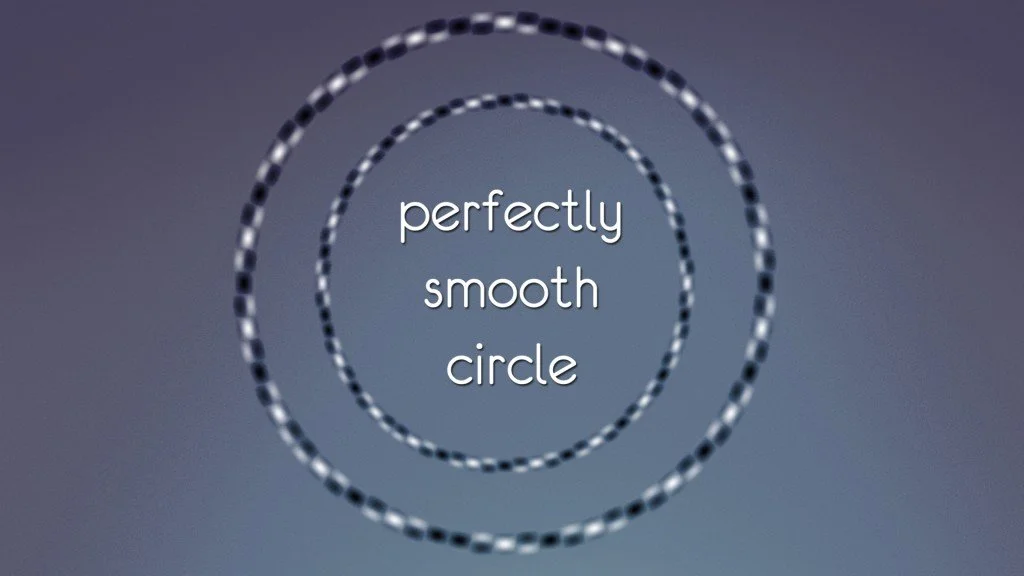
We rarely perceive perfection in the world around us. We look at ourselves, others, and life in general in a way that we believe is objective and affirm that what we see is truth. Instead of seeing two, perfectly smooth circles, we see “wobbles.” Our mind tells us that the truth of the "perfectly smooth circle" is clearly otherwise, that it is full of imperfections, curves and irregularities. But, no matter how convinced we may be of the accuracy of our perception, what if it actually isn't true? What if, despite appearances, our lives are actually perfect? This has pretty amazing implications worth considering. Really, what if?
As hard as it may be, the best way to keep from being misguided by misperceptions like this is to see beyond the immediately apparent to gleam the greater truth. Instead of allowing the nuances (the black and white areas within the two circles above) to distort your perception of reality, aim to view the whole as it actually is (the perfectly smooth circle). Give all moments exactly equal weight, seeing them not as “good” or “bad,” not black or white, but just as part of the perfectly smooth circle that is your life.